
Our view
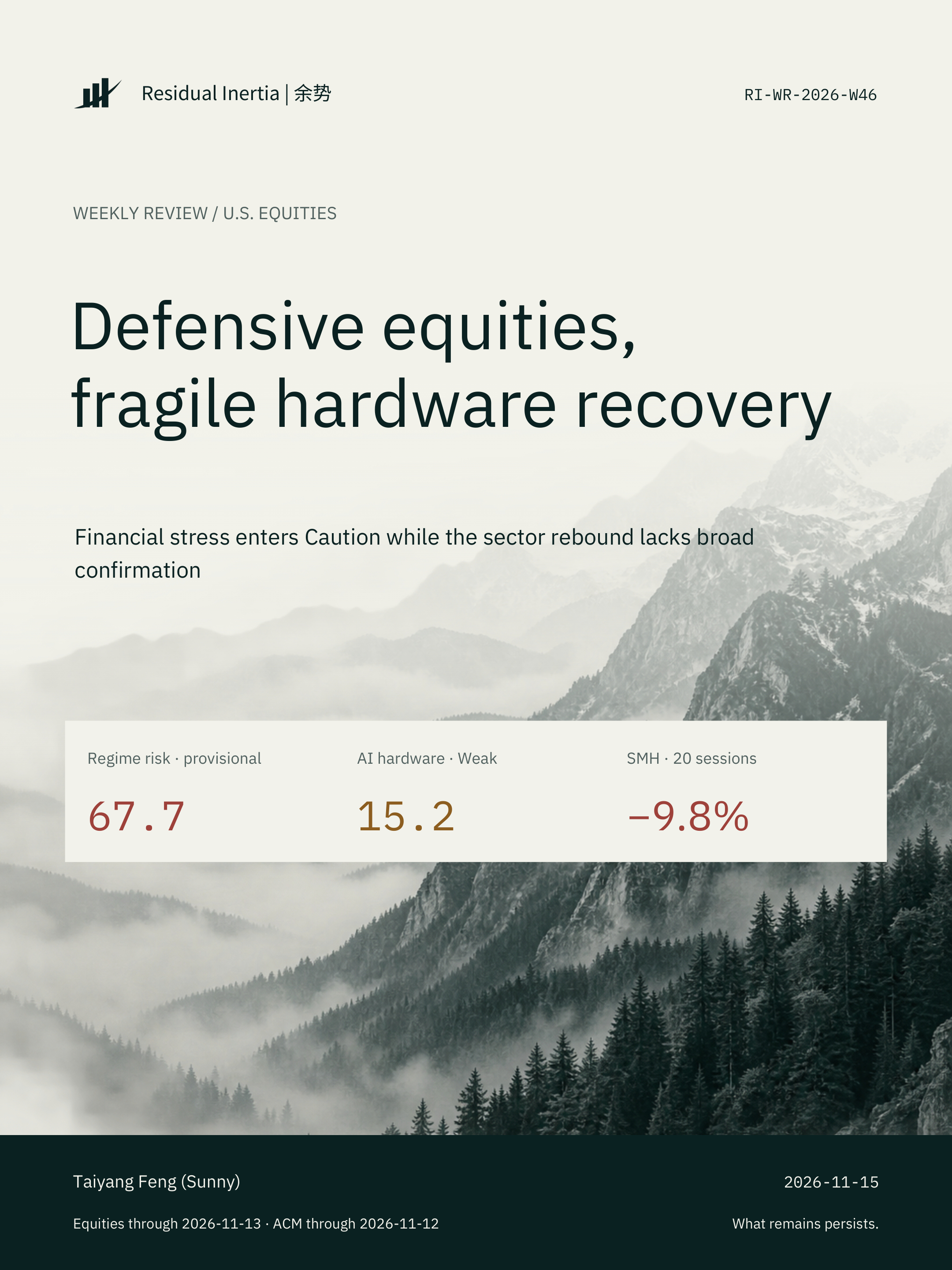
As of November 13, the provisional U.S. composite regime risk score was 67.7, in the Defensive range. Market risk and fragility remained elevated, while financial stress entered Caution at 53.6. The semiconductor and AI hardware score recovered to about 15, but SMH was still down 9.8% over 20 sessions. Term premium compression drove the decline in long yields over 21 observation intervals. The research stance remains defensive pending sustained improvement in market breadth and industry momentum. Scores are not directly comparable across model versions.
Author: Taiyang Feng
Report ID: RI-WR-2026-W46 · v1.0
Defensive conditions and weak internal support
The U.S. composite regime risk score was 67.7 on November 13, in the Defensive range. Market risk and fragility were both in Stress at 81.9 and 88.3. Participation risk was Neutral at 47.0, while financial stress entered Caution at 53.6.
Limited breadth, factor crowding and trend fragility continue to constrain risk appetite. About 44.8% of stocks traded above their 200-day moving average that day, leaving participation below half. Livermore S2 was Active at 82.3, flagging the risk of upside exhaustion. Internal support remains weak.
The financial conditions inputs used by the composite were dated November 6. The NFCI was −0.462 and the ANFCI −0.477, a spread of +0.015. Both indices remained below zero. The Caution reading for financial stress warrants continued attention to credit and funding conditions. The evidence remains insufficient to establish a systemic liquidity crisis.
Hardware improves with limited confirmation
The semiconductor and AI hardware composite recovered to 15.2 on November 13, displayed as 15 on the headline card, but remained Weak. SMH gained 4.9% over five sessions and was still down 9.8% over 20 sessions, trailing QQQ by about 5.6 percentage points. The short rebound has yet to reverse its relative weakness.
Of the 28 monitored stocks, 25% traded above their 20-day moving average and about 21% above their 50-day average. Demand momentum scored just 8, supply-chain confirmation 16, leadership breadth 22 and relative risk appetite 34. Divergence fragility remained high at 80, leaving the recovery without broad confirmation.
Over 20 sessions, NXPI, MPWR and ANET gained 15.6%, 14.8% and 11.5%, respectively. INTC, MRVL and NVDA fell 33.6%, 31.2% and 23.9%. No monitored stocks in either the foundry and equipment group or the memory and storage group stood above their 20-day moving average. The recovery remains uneven.
Term premium compression offsets higher expected rates
On November 12, the New York Fed’s published ACM model put the fitted 10-year Treasury yield at 5.066%. The expected short-rate component was 4.390% and the term premium was 0.675%. Displayed levels are rounded.
Across the 21 observation intervals from October 13 to November 12, the fitted yield fell 12.65 basis points. Expected short rates contributed +5.22 basis points and the term premium −17.87 basis points. The components moved in opposite directions. Term premium compression more than offset the rise in expected rates.
The net decline eases some long-rate valuation pressure. With expected short rates still contributing upward pressure, the equity allocation case also depends on progress in market breadth and industry momentum.
Stay defensive pending broader participation
The research stance remains defensive, with exposure to highly crowded assets kept in check. The semiconductor rebound shows some localized improvement, while demand momentum, supply-chain confirmation and leadership breadth remain weak. Evidence for taking more risk is still limited.
Before raising exposure, look for sustained improvement in market breadth and stabilization in semiconductors relative to QQQ, supported by demand and supply-chain indicators. With financial stress in Caution, further tightening in credit and funding conditions also merits attention.
HML coverage gates and estimation rules continued to change this week, while UMD retains a proxy input. The 67.7 reading is provisional and cannot be compared directly across model versions. Equity and hardware observations end November 13, financial conditions inputs end November 6, and ACM data end November 12. Each module uses its latest eligible observations.
Sources & Limitations
RI U.S. Market Research Dashboard, Chicago Fed NFCI / ANFCI, and New York Fed ACM data. The composite regime risk score is provisional.
- [1] Frozen observations for this edition
- [2] RI U.S. market dashboard
- [3] Chicago Fed financial conditions indices
- [4] New York Fed ACM term premia
For research purposes only. Not investment advice. Past performance does not guarantee future results.